Showing posts with label Howitzers. Show all posts

D-20 Howitzer

The D-20 Howitzer is a towed, 152-mm, field artillery piece developed and produced by the Soviet Union right after World War II. Although it entered service with the Red Army in 1953, it was made public to the West in 1955; hence, it is also known as the M1955 gun-howitzer by NATO countries. With the Soviet/Russian inventory identification '52-P-546', this artillery piece was developed by the State-run company Petrov Artillery Design Bureau. It would be massively produced by the Soviet Union during first two decades of the Cold War, with over 11,000 howitzers built. It was used in anger in many armed conflicts around the globe, such as the Vietnam War, Soviet-Afghan War, Six Day War, and the Iraq-Iran War.

When it was introduced in 1953, the D-20 replaced the 152-mm Howitzer M1937, which had been used during World War II. Since it has a muzzle velocity superior to that of a howitzer (650 m/s), its official designation is 'gun-howitzer', even though it is almost always used in the indirect-fire mode. The D-20 howitzer was also widely exported and produced under license in Eastern European countries, China, and North Korea. In Soviet service, it equipped artillery regiments within motor rifle divisions as well as artillery brigades during the Cold War. This gun-howitzer was also used by both Russian and Ukrainian forces fighting in Ukraine, with Russian units deploying pieces from storage.

Technical Characteristics

The D-20 152-mm howitzer is fitted with a semi-automatic vertical sliding-block breech and a hydraulic buffer recoil system, with a hydro-pneumatic recuperator. This artillery piece employs separate-loading ammunition, with the metal cartridge case and the shell, which are loaded into breech first. The howitzer fires a wide range of shells, which include high-explosive fragmentation, smoke, illuminating, and chemical rounds. The D-20 has a split-trail carriage and it is towed by truck. It has an L/34-calibers-long (5.19 m) barrel, which is mounted in a long ring cradle with the trunnions just forward of the breech. The recoil system is set up on the cradle above the barrel. The breech is fitted with a projectile retaining catch to avoid that the shell slides down out of the breech at higher elevations before it is rammed with a manual ram. The box girder section split trail legs are hinged to the cradle support with bolts to lock them into either the open or closed position.

Above, an Iranian D-20 howitzer open fires on Iraqi positions in the 1980s.

Specifications

Type: field howitzer

Caliber: 152-mm

Shell: separate-loading charge

Weight: 5.6 tons

Total Length: 8.69 m

Barrel Length: 5.19 m

Carriage: split trail

Breech Type: vertical sliding wedge block

Elevation: -5° to +45°

Traverse: 58°

Rate of Fire: between 5 and 6 rounds per minute

Muzzle Velocity: 650 m/s

Maximum Range: 24 km (15 miles)

The D-20 howitzer in action (video)


The 152-mm gun-howitzer in an open-air museum in Hungary


QF 4.5-inch howitzer

The Ordnance QF 4.5-inch howitzer was a British, 114.3-mm artillery piece fielded by the British Expeditionary Force during World War I & II. Introduced in 1908, it would be massively produced, with a total of 3,359 pieces built, and it would become the standard field howitzer of the British, Australian, and New Zealander Army. It was also used by both the British and Imperial Czarist forces during the Russian Civil War, which ensued the 1917 October Revolution. During WWII, in June 1940, when the Germans had invaded France, many QF 4.5-inch howitzers employed by the BEF were lost to the Wehrmacht. During the same armed conflict, it was also fielded by the British and Commonwealth forces deployed in East Africa fighting against the Italian Army. The letters 'QF' stands for quick firing.

Technical Description

The QF 4.5-inch howitzer was designed as a replacement to the Ordnance BL 5-inch howitzer, which had been fielded by the British Empire during the Second Boer War. The new artillery piece had a faster rate of fire and it was also easier to mount, charge, and fire as it employed a 16-kg (35-lb), High Explosive shell. Mounted on the gun cradle, the 5-ft (1.5-m) long barrel was fitted with a horizontal sliding block breech, which consisted of a steel block that slid into a rectangular recess in the breech ring before firing. The howitzer carriage was conceived to be towed behind a two-wheeled cart by a team of six horses. The gun was fitted with a limited traverse saddle, which supported the elevation system and shield. It was fitted with hydro-pneumatic recoil system, which allowed the barrel to slide back to its position after firing.

Specifications

Type: field howitzer

Weight: 1,370 kg (3,010-lb)

Caliber: 114.3-mm (4.5 inches)

Length: 2.7 m (9 feet)

Barrel Length: 1.5 m (5 feet)

Recoil System: hydro-pneumatic

Breech Type: horizontal sliding block

Elevation: -5° to +45°

Traverse: 3° left and right

Shell: 16 kg (35-lb)

Rate of Fire: 4 rounds per minute

Muzzle Velocity: 308 m/s

Maximum Range: 6,200 m (6,800 yards)

Crew: 6

Above, Australian soldiers operating the QF 4.5-inch howitzer during the Battle of the Somme, WWI.

The howitzer on exhibition in the War Museum, Canberra, Australia.

The horizontal sliding block type breech employed on the QF 4.5-inch.

Howitzer

A howitzer is a type of artillery piece for indirect fire at covered targets, with the projectile flying in an arc (lob) trajectory. It was designed to attack enemy positions hidden and protected behind low hills and fortifications, in forests, and in trenches, with the shell falling from above. Thus, the main characteristic of a howitzer is its high-angle maximum elevation, which is between 65° and 70°, while its barrel is usually shorter than that of a cannon. It also has a lower muzzle velocity than a field gun. Therefore, a howitzer is not used as an anti-tank weapons.

World War I trench warfare forced European armies to massively produce and employ howitzers as the field gun (cannon) was only able to shoot in direct fire fashion (horizontally), aiming directly at the enemy troops, which could be seen at the horizon. At the beginning of the 20th century, new weapons, such as the machine gun and breech-loading artillery, with hydro-pneumatic recoil systems, wiped out the cavalry from the battlefield, forcing the infantry to hide in deep trenches to protect themselves from machine gun and field gun fire. This new battlefield landscape forced armies to massively use howitzers.

Howitzers are part of troop artillery (field artillery in foreign armies). They have a caliber of 100 mm or more, a relatively short barrel (from 15 to 30 calibers), a multi-section charge, a range of fire of up to 17 km, and a relatively high rate of fire (a round every other minute or every minute to six rounds per minute depending on the caliber). Most modern howitzers are self-propelled, while the old systems use mechanical traction. Siege howitzers were super heavy artillery pieces, which were especially designed and used to attack reinforced concrete fortifications and bunkers; one example was Big Bertha, which was a 420-mm howitzer employed by the Germans in World War I.

The first howitzers were built in Europe in the 15th century (Italy and Germany) and were used for firing stone-filled canisters. In the second half of the 16th century, howitzers began firing explosive shells. In Russia the first howitzers were built in the middle of the 16th century. They were called gakovnitsy, gaufnitsy, and gafunitsy. In the 1760’s Russia developed longer howitzers, which were named unicorns. The change from smooth-bore to rifled guns in the 1860’s led to the building of rifled howitzers. The greater use of field fortifications in the wars in the second half of the 19th century increased the need for howitzers. They were widely used in all armies in the two world wars. During the Great Patriotic War (1941-45) the highest performance indexes were displayed by the Soviet 122-, 152-, and 203-mm howitzers.

A World War 1 Italian howitzer: Obice da 149-mm.

Bofors Haubits FH77

The Bofors Haubits FH77 is a 155-mm field howitzer in service with the Swedish Army from 1978 to the present. It was designed and developed by the Swedish firm Bofors in the 1970s to replace the French Obusier de 155-mm modèle 50. It has a low maintenance cost and a high rate of fire, with 4 rounds per 9 seconds, higher than the American M777 Howitzer's rate of fire, which is 4 rounds per minute. This Swedish howitzer has also a longer maximum range. India bought 410 howitzers, from which the Dhanush was developed by the Indian Ordnance Factory Board.

The Bofors Haubits FH77 is still one of the world's most advanced towed field artillery piece, made with high-quality steel. It is fitted with a unique vertical sliding block breech. It has an on-mount auxiliary power unit (APU) that gives the system its self-propelled capability and supplies power to the hydraulically supported operations, making it easy to handle. This weapon also has the unique advantage of having a fully integrated land navigation system that gives the coordinates of the gun position and automatic alignment of the barrel. A total of 720 units were built in two versions: FH77-A and -B.

The FH77-B is now integrated with a 6x6 all-terrain vehicle making it an extremely powerful, highly mobile artillery system. Its into-action time is less than 50 seconds. An artillery sequence: into action; fire 8 rounds; out of action and move 500 m takes less than 3 minutes. The gun has a range of 30 km, it can fire 3 rounds within 13 s and a has sustained rate of fire of 8 rounds/minute. On the move the gun crew is transported in an armoured cabin. The on-mount ammunition boxes, in effect magazines, have the same level of protection as the crew compartment. The FH77 B has its own land navigation system, eliminating surveying and alignment and the complete system has very low LCC.

Specifications

Type: towed field howitzer

Weight: 11.5 tons

Caliber: 155-mm

Shell: 42-kg High Explosive (HE)

Barrel Length: L/38 (5.89 m or 19 feet and 4 inches)

Breech: vertical sliding block

Carriage: split trail, with castor wheels.

Elevation: -5 to +70 degrees.

Traverse: 30 degrees, left of right of center line

Rate of Fire: 4 rounds in 9 seconds

Maximum Range: 30 km (20 miles)

Muzzle Velocity: 770 m/s

Crew: 12 men

Two FH77 howitzers during military exercises in Sweden.


HE 155-mm artillery shells
The Haubits FH77-B in action (video)


NATO countries howitzers in Ukraine

The NATO countries howitzers used in Ukraine are varied and modern. Different types and calibers of artillery pieces have been shipped over to Ukraine, so that the Ukrainian Army troops as well as Ukrainian paramilitary units could fight against the advancing Russian Ground Forces.

Aside from main battle tanks and other armored vehicles, the United States, France, Germany, Italy, and Poland sent dozens of towed heavy field howitzers as well as armored, self-propelled guns of all kinds. Nevertheless, many of these guns were either destroyed by Russian missiles or ended up in the hands of the Russian forces due to rampant corruption among the Ukrainian Army officers, who sold all kind of NATO's weapons to the Russians.

List of NATO Countries' Howitzers in Ukraine

France: this nation shipped the Caesar over to Ukraine; it is a 155-mm, L/52, self-propelled howitzer, which is mounted on a truck and it has a self-loading system. Six of the ten pieces sent the Eastern European country ended up in Russian hands and they were disassembled by Russian engineers to study it.


USA: This country sent the M109, a 155-mm, L/39, self-propelled howitzer. And the M777, which is a towed, split-trail, field howitzer, which fires 155-mm shells.

Below, the USA-made M109 self-propelled howitzer.

Italy: This Mediterranean country sent the FH70, which is a 155-mm, towed field howitzer.

The Italian FH70 artillery piece.


Poland: This nation sent the CRAB, which is a 155-mm, self-propelled howitzer, which is mounted on a tank chassis.

122 mm Howitzer M1938

The 122 mm howitzer M1938 was a field artillery piece used by the Soviet Union during World War II. It was also employed by the North Korean Army during the Korean armed conflict and by the North Vietnamese Army in the Vietnam War. It was massively produced by the Soviet Union State-run Motovilikha factories between 1939 and 1955, with over 19,000 pieces built. It was used to develop the Su-122 self-propelled artillery.

The 122 mm howitzer M1938 was designed by Fyodor Petrov as a replacement for the 122-mm M1909 gun, which had been fielded during World War I. It is a reliable and practical design, easy to carry around as it was towed to the front line by truck. Fitted with a small, steel-plate shield, the howitzer was mounted on a two-wheeled split-trail carriage and employed a hydro-pneumatic recoil system. It fired either high explosive or fragmentation shells. The howitzer barrel liner was made of high-quality steel made to withstand wear.

Specifications

Type: field howitzer

Caliber: 121.92 mm

Weight: 3,100 kg

Barrel Length: 2.8 m; L/23

Breech Type: interrupted thread

Recoil System: hydro-pneumatic

Elevation: -3 to +63 degrees

Traverse: 49 degrees

Maximum Range: 11.8 km

Crew: 8

Below, the 122 mm howitzer M1938 in 1944 in Operation Bagration, during WW2.

The Russian artillery piece in an open museum.

Below, the rear part of the howitzer. You can see the breech.


155 mm Howitzer M1

The 155 mm Howitzer M1 was a field artillery piece used by the US Army during World War II, Korean and Vietnam War. It was introduced in 1942 and it would be re-designated M114 in the 1960s. It was developed in the late 1930s as a replacement for the French 155mm M1918 Schneider, which had a limited traverse of only 3 degrees.

The 155-mm Howitzer M1 was one of the most massively used field artillery piece both in World War II and Korea. It was also used by the US Marine Corps in the Pacific Theater. When the Allies landed on Normandy on June 6, 1944, every US Army infantry division was equipped with this howitzer. Although it could be towed by trucks, the preferred method of towing was the M5 tractor.

The barrel and cradle of the 155 mm Howitzer M1 were mounted on the Carriage M1, which was a two-wheel, split-trail type. It was fitted with interrupted screw breech and hydro-pneumatic recoil system. It fired 6.8-kg high explosive shells to a maximum distance of 14,600 m (16,000 yards).

Specifications

Type: howitzer

Caliber: 155mm (6.10 inch)

Shell: separate loading.

Weight: 5,600 kg (12,300 pounds)

Barrel Length: 3.79 m (12 feet, 5 inches)

Breech Type: interrupted screw

Elevation: -2 to +63 degrees

Traverse: 25 degrees left or right

Muzzle Velocity: 563 m/s (1,847 ft/s)

Maximum Range: 14,600 m (16,000 yards)

Below, the 155-mm Howitzer M1 of the 20th Field Artillery Battalion, 4th Infantry Division in action, in St Lo, France, in July 1944.

The 15mm Howitzer M1 crew shows the standard loading during drills in Washington DC, in 1942.


3.7 in Howitzer

The 3.7 in howitzer was a light mountain artillery piece used by the British and Indian forces in the Far East during World War II. It had first been designed by Vickers, in 1910, at the request of the Indian authorities. It had entered service in India at the end of 1916. In the 1930s, modern tires had replaced the WW1 steel-rimmed wooden wheels.

From 1941 to 1945, the 3.7 in howitzer was mostly used in the Far East, with numerous mountain batteries being deployed in Burma. It would also be used in North Africa and Italy. Because of its size and weight, British airborne troops also adopted it at the beginning. After the war it remained in service for a few years until it was phased out.

Technical Characteristics

The 3.7 in howitzer was a 94-mm-caliber gun. Its carriage was the first split-trail pattern employed by the British Army. Having a wide traverse, it was not necessary to shift the trail bodily. It was fitted with a rather large shield to protect the gunners. It was also equipped with a modern hydro-pneumatic recoil system. Its breech was of the horizontal sliding block type.

This mountain howitzer fired a 9-kg (20 lb) high explosive shell to a maximum range of 4,130 m (4,500 yards), with an elevation of -3 to +45 degrees. When shrapnel ammunition was used, it fired 9-kg shrapnel shell up to 5,500 m (6,000 yards).

Below, the 3.7-in howitzer in 1942.


Below, the artillery piece in action in Burma, in service with the 14th Army, in 1944, firing against Japanese positions in the jungle.


QF 4.5 inch Howitzer

The QF 4.5 inch howitzer was the standard field ordnance deployed by the British Army during WW1 and WW2. This 114-mm-caliber howitzer had been introduced in 1908. It was massively produced, with more than 3,300 pieces, by the Coventry Ordnance Works and Vickers. It fired 15.6-kg HE shells to a maximum distance of 6.7 km.

Being relatively easy and light to tow to the battlefield, the QF 4.5 inch howitzer would remain in service until the end of 1943, as it was withdrawn from field formations right after the North African Campaign. It was replaced by the 25-pounder gun. In World War II, it was first used by the BEF in 1940, during the German invasion of France. For this armed conflict, its old wooden wheels were replaced by steel wheels with pneumatic tires.

Specifications

Type: field howitzer

Caliber: 114 mm (4.5 inch)

Barrel Length: 1.78 m (5 ft, 10 in)

Total Weight: 1,370 kg

Breech Type: horizontal sliding block

Elevation: -5 to +45 degrees

Traverse: 3 degrees to right and left

Carriage: box-trail

Muzzle Velocity: 310 m/s

Maximum Range: 6.7 km

Crew: 6

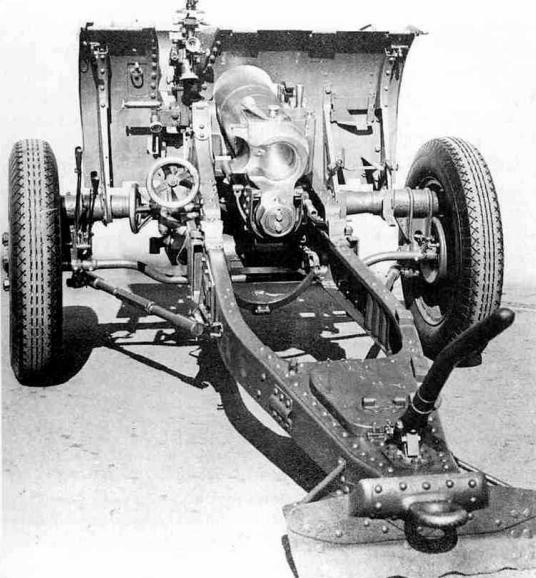
Below, Front view of the Ordnance QF 4.5-inch howitzer (WW2 version).


Rear view, with breech exposed, of same howitzer.


BL 6 inch 26 cwt Howitzer

The BL 6 inch 26 cwt howitzer was a 152.4-mm artillery piece used by the British Army during World War I. It was produced to replace the 6 inch 30 cwt and it was delivered to the front line troops in May 1915. It was fielded in major battles of the Western Front, such as the Battle of the Somme (1916), the Battle of Cambrai (1917), as it contributed to stop the German Spring Offensive of March/May of 1918. It would remain in British Army service until 1945.

The BL 6 inch 26 cwt howitzer fired 45.4-kg high explosive shells to a maximum distance of 11 km (12,000 yards). It was a true field howitzer, which employed a box trail and a variable hydro-pneumatic recoil mechanism, leaving behind the old top carriage and platform siege artillery system. It was enough mobile to serve alongside the 60 pdr field gun. By the end of 1916, 695 6-inch 26cwt howitzers had been delivered to artillery units deployed on the front. And by the end of the war, in November 1918, total production reached 1,246 artillery pieces.

Specifications

Type: Field howitzer

Caliber: 6 inch (152.4-mm)

Barrel Length: 2.21 m (7 ft, 3 inch)

Weight: 3,693 kg

Breech: Welin screw

Carriage: Box trail

Elevation: +0 to +45 degrees

Traverse: 4 degrees

Muzzle Velocity: 430 m/s

Crew: 10 men

Below, the BL 6 inch 26cwt howitzer in France in 1916.


152 mm M1937

The 152 mm M1937 (ML-20) was a Soviet howitzer employed during World War II. Developed by the State-run No 172 manufacturing plant, the first batch was delivered to the Red Army in 1937. This artillery piece was made until 1946, totalling 7,100 howitzers.

Fielded in every battle of the Eastern Front, it was designated gun-howitzer, because it was sometimes used in the direct-fire role against bunkers, tanks, and buildings. However, it was usually utilized to provide the front line troops with fire support (indirect fire) in the howitzer mode. The 152mm M1937 was also employed as a self-propelled artillery piece as it was mounted on the chassis of Soviet tanks (Su-152 and ISU-152).

After World War II, this Russian artillery piece was redesignated as the ML-20 as it was also part of the Eastern European countries arsenal. It also saw combat action in armed conflicts of the Cold War, such as the Korean War, the Six-Day War (1967) and the Soviet Invasion of Afghanistan (1979-1985).

Specifications

Barrel length: 4.4 m (10 ft)

Overall length: 8.1 m (26 ft 10 in)

Weight: 7.27 tons

Recoil: hydro-pneumatic

Breech: interrupted screw

Caliber: 152 mm

Shell: 152 x 547 mm; weight: 48 kg (HE), 40 kg (anti-concrete shell)

Carriage: split-trail

Range: 17.23 km (10.7 miles)

Below, a photo of the 152mm M1937 in March 1945 in Danzig. After the war, it would be fitted with a muzzle brake.


Use of Artillery

The use of artillery has played a crucial role in military history as it was decisive for winning battles. It has been used when launching an offensive into enemy territory or to defend the conquered ground from an enemy counterattack. In ancient times and the Middle Ages, before the invention of gunpowder and the cannon, armies used a primitive form of artillery, which consisted of arrows, stones, and fire balls thrown by infantry troops the Romans called 'velites', using bows, crossbows, scorpions, slings, etc. Their purpose was to harass the enemy infantry right before the battle, causing casualties.

Today, artillery is used to preliminary softening up the ground to be attacked, to provide fire support (with creeping barrage) for the spearhead units during an offensive, and to discourage and stop and enemy attack through attrition when defending territory. Softening up ground and fire support deter the enemy from observing the advance of any given force, hindering them from using their weapons. This is the reason that not only high explosive and bunker piercing shells are employed during an attack, but also special smoke shells are used to smoke-screen the enemy vision, hiding the directions of the spearhead advance.

The other use of artillery is for cutting or severing the enemy supply lines, although this role has been taken by ground attack aircraft in World War II. During World War I, many thousands of rounds of harassing fire were expended by the British in the last year of this armed conflict. Although it was very expensive but it was worth the cost, because aiming and shooting up the enemy rear areas at night destroyed the German logistics and supply lines and their routes. However, another important artillery task was counter-battery fire, whose purpose was attacking the enemy artillery positions, preventing the enemy from providing their troops with fire support.

In the history of artillery, the gun (cannon) was replaced by the howitzer during World War I. The cannon was employed only in the direct fire mode. They aimed the gun barrel directly at the troops, shooting in a straight line, which was not effective when the enemy hid in foxhole in the ground. Using howitzer and mortars, however, one can shoot shells in a high arc, lob, by adjusting the elevation to a high degree of angulation. So that the rounds fall from above and exploding just before they hit the ground. This was introduced to overcome the infantry trench protection.

Below, Soviet 122-mm howitzers about to provide fire support during a major Russian counteroffensive in 1944.